

sample preparation for EBSD use in structural characterization of pyroxenes

Colleagues,
We are exploring the use of EBSD for the structural determination of pyroxenes in run products from piston cylinder experiments. We have discovered that our "standard" polishing approach will not work and we need a shaker (vibrating) lap to get the level of polish for structural characterization. Does anyone have advice on best practices for EBSD preparation of experimental products embedded in one-inch round epoxy plugs for structural determination? We would appreciate any recommendations on the subject.
Thanks!
Gokce
Gokce K. Ustunisik, Ph.D. (she/her/hers)
Associate Professor, Department of Geology and Geological Engineering
501 E. St. Joseph St.x-apple-data-detectors://1/1
South Dakota Schoolx-apple-data-detectors://1/1 of Mines and Technology (SD Mines)
Rapid City, SD 57701x-apple-data-detectors://2/0
Gokce.Ustunisik@sdsmt.edumailto:Gokce.Ustunisik@sdsmt.edu
Research Associate, Department of Earth and Planetary Sciences
Central Park W.79th St.x-apple-data-detectors://3/1
American Museumx-apple-data-detectors://3/1 of Natural History (AMNH)
gustunisik@amnh.orgmailto:gustunisik@amnh.org
Phone: 513-315-6131tel:513-315-6131
"My work hours may be different than yours. Please do not feel obligated to reply outside of your normal work schedule."

Hi Gokce
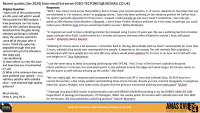
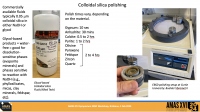
An enquiry about polishing for EBSD was asked a few years ago on the GEO-TECTONICS email list server, copied below and as screen shots of a few slides from an EBSD workshop I gave a few years ago for AMAS in Brisbane (attached).
Original Question:
I have a set of thin sections that are 20+ years old which I would like to polish for EBSD analysis. I have previously run into issues with old thin sections becoming detached from the glass during vibratory polishing in colloidal silica; the sections started to come off of the glass after 4 hours. I think the epoxy has degraded through time and cannot hold up to the vibrations. Not really sure.
I am wondering:
-
Have others run into this issue and how have you circumvented it? and
-
What is the minimum time you have polished your sample -- on a vibratory polisher with colloidal silica -- and obtained high-quality patterns?
Much thanks,
Drew A. Levy, Ph.D.
Responses:
“Well, I have never come across that problem, but to answer your second question, it, of course, depends on the phase that you are interested in. For instance, when I'm analyzing calcite, I have only been polishing on the vibratory polisher for half an hour. For quartz I generally vib-polish for three hours. I suspect I could actually go less, but I haven't tested that. I also only vib-polish at 30% vibration level (Buehler's Vibromet...I don't know if other vibratory polishers do it this way), so perhaps you could reduce your vibration level and you would have better success.” Matty Mookerjee
“In Liverpool we used to have a vibrating polisher but stopped using it some 15 years ago. We use a polishing lap that circulates syton [colloidal silica fluid]. I polish calcite for 5 minutes and quartz and most other silicates for around 1 hour, with great results.” Elizabetta (Betty) Mariani
“Polishing of 4 hours seems a bit excessive. I remember back in the day, Steve Reddy told me that if I would polish for more than 3 hours, colloidal silica would start reacting with the sample. It depends on the sample The soft minerals (like sulphides), I would polish with more weight but less time (40 min), while I would polish gabbros for an hour, or an hour and a half with only one weight on it.” ZojaVukmanovic
“I use the same setup as Betty (circulating polishing lap with SYTON). I find 1 hour is fine for hard sulphides like pyrite. Calcite polishes in 5 minutes, but associated quartz is only polished around the edges and needs longer. 30 minutes seems to get the quartz as well without messing up the calcite.” Alan Boyle
“We use a fairly soft, thin neoprene pad (comparable to MD-chem) and OP-U (non-dry) colloidal silica, 20-30 N force for a normal thin section, a fast rotary polisher and polishing times of 2-6 minutes. Results are nice, minimal topography in polyphase materials, quartz, feldspar, mica index nicely, all given that the previous mechanical polishing was really good.” Rüdiger
“I have got very good EBSD results in polymineralic rocks with BROAD ION BEAM polishing in my lab (FABRIC ANALYSIS LAB), Department of Geology and Geophysics, IIT Kharagpur, INDIA. We usually polish 30 minutes with colloidal silica and then BIBP for 30 minutes. We have published a polishing protocol.” Manish Mamtami
I hope that this helps!
Regards,
Nick
A/Prof Nick Timms
Associate Professor | Director of the Space Science and Technology Centre
School of Earth and Planetary Sciences
Faculty of Science & Engineering
Are you interested in a PhD scholarship in asteroid sample return sample analysis:
https://research.curtin.edu.au/hdr-r-projects/unlocking-solar-system-secrets-from-asteroid-sample-return-missions/
(Application deadline 15 March 2026)
Read about our latest research:
Pristine asteroid samples reveal secrets of the ancient solar systemhttps://www.curtin.edu.au/news/media-release/pristine-asteroid-samples-reveal-secrets-of-the-ancient-solar-system/
New analysis of asteroid dust reveals evidence of salty water in the early Solar Systemhttps://theconversation.com/new-analysis-of-asteroid-dust-reveals-evidence-of-salty-water-in-the-early-solar-system-248439
Curtin University
Tel | +61 8 9266 4372tel:+61892664372
Mobile | +61 427 324199tel:+61427324199
Web staff profile | Associate Professor Nick Timmshttps://staffportal.curtin.edu.au/staff/profile/view/nick-timms-b452975d/
Centre website | SSTChttps://sstc.curtin.edu.au/
[signature_3154428837]
Curtin University is a trademark of Curtin University of Technology.
CRICOS Provider Code 00301J (WA), 02637B (NSW)
Please note, my working hours may not be yours, so please don’t feel obliged to reply to this e-mail outside of your normal working hours.
From: Ustunisik, Gokce K. via MSA-talk msa-talk@minlists.org
Date: Thursday, 26 February 2026 at 9:05 pm
To: 'msa-talk@minlists.org' msa-talk@minlists.org
Subject: [MSA-talk] sample preparation for EBSD use in structural characterization of pyroxenes
Colleagues,
We are exploring the use of EBSD for the structural determination of pyroxenes in run products from piston cylinder experiments. We have discovered that our "standard" polishing approach will not work and we need a shaker (vibrating) lap to get the level of polish for structural characterization. Does anyone have advice on best practices for EBSD preparation of experimental products embedded in one-inch round epoxy plugs for structural determination? We would appreciate any recommendations on the subject.
Thanks!
Gokce
Gokce K. Ustunisik, Ph.D. (she/her/hers)
Associate Professor, Department of Geology and Geological Engineering
501 E. St. Joseph St.
South Dakota School of Mines and Technology (SD Mines)
Rapid City, SD 57701
Gokce.Ustunisik@sdsmt.edumailto:Gokce.Ustunisik@sdsmt.edu
Research Associate, Department of Earth and Planetary Sciences
Central Park W.79th St.
American Museum of Natural History (AMNH)
gustunisik@amnh.orgmailto:gustunisik@amnh.org
Phone: 513-315-6131tel:513-315-6131
“My work hours may be different than yours. Please do not feel obligated to reply outside of your normal work schedule.”


Hello Gokce,
You can check my paper from 2009 (https://academic.oup.com/mam/article/15/3/197/6920082?login=true) in which I described a method to polish any mineral for EBSD. It has been successful for my samples (which I polish by hand), and I have only removed the part of colloidal silica from my current protocol. If you have any questions, please, let me know.
Best,
Alberto
From: Ustunisik, Gokce K. via MSA-talk msa-talk@minlists.org
Date: Thursday, February 26, 2026 at 7:01 AM
To: 'msa-talk@minlists.org' msa-talk@minlists.org
Subject: [EXTERNAL] sample preparation for EBSD use in structural characterization of pyroxenes
Colleagues,
We are exploring the use of EBSD for the structural determination of pyroxenes in run products from piston cylinder experiments. We have discovered that our "standard" polishing approach will not work and we need a shaker (vibrating) lap to get the level of polish for structural characterization. Does anyone have advice on best practices for EBSD preparation of experimental products embedded in one-inch round epoxy plugs for structural determination? We would appreciate any recommendations on the subject.
Thanks!
Gokce
Gokce K. Ustunisik, Ph.D. (she/her/hers)
Associate Professor, Department of Geology and Geological Engineering
501 E. St. Joseph St.
South Dakota School of Mines and Technology (SD Mines)
Rapid City, SD 57701
Gokce.Ustunisik@sdsmt.edumailto:Gokce.Ustunisik@sdsmt.edu
Research Associate, Department of Earth and Planetary Sciences
Central Park W.79th St.
American Museum of Natural History (AMNH)
gustunisik@amnh.orgmailto:gustunisik@amnh.org
Phone: 513-315-6131tel:513-315-6131
“My work hours may be different than yours. Please do not feel obligated to reply outside of your normal work schedule.”